Precision robotic technology. Smaller incisions. Faster recovery. Greater accuracy around lymph nodes and blood vessels. Performed by a surgeon at the controls — not a machine operating alone.
Last reviewed: April 2026 · Dr Lawrence Okiror FRCS(CTh) FRCSEd(CTh)
The most common question I hear in clinic: "Will a machine be operating on me?" The answer is no — not in any meaningful sense. I sit at a surgical console and control every movement of every instrument, in real time. The robot does not act independently. It cannot make decisions. It does not move unless I move.
What the da Vinci robotic system gives me is something I cannot achieve any other way: a magnified, three-dimensional high-definition view inside the chest; instruments that bend and rotate through a far wider range of motion than the human wrist; and the elimination of hand tremor. The result is greater precision, less tissue damage, and consistently better outcomes for patients.
I lead the Cardiothoracic Surgery Robotics Advisory Panel at the Royal College of Surgeons of Edinburgh — the body that sets national guidance on robotic surgery in thoracic practice. At GSTT, 57.8% of lung cancer operations are now performed robotically, more than double the national average of 24%.
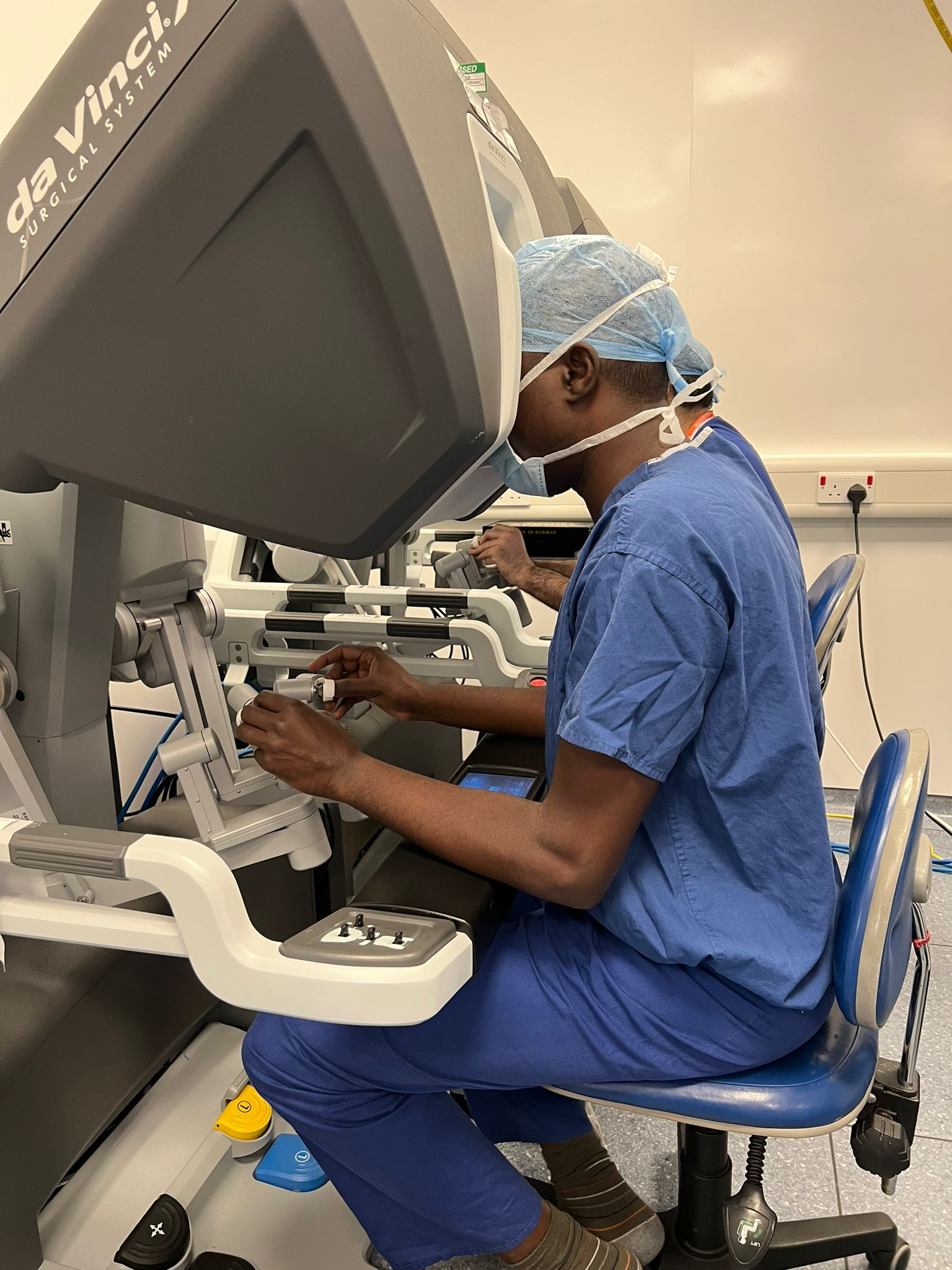
The clinical case for robotic thoracic surgery has strengthened considerably in recent years. Beyond the well-established benefits of minimally invasive surgery — shorter hospital stays, less pain, faster recovery — robotic surgery offers a specific oncological advantage that open and VATS approaches cannot match.
The precision of robotic instrumentation allows more thorough lymph node dissection during lung cancer surgery. Research published in the European Journal of Cardio-Thoracic Surgery (2026) confirms that improved lymph node yield from robotic resection independently predicts better survival in non-small cell lung cancer — meaning the operation itself influences long-term outcome, not just the tumour biology.
In practical terms: a robotic operation takes longer to set up, requires more investment in technology and training, and demands a higher operative volume to perform well. The fact that GSTT performs 57.8% of its lung cancer surgery robotically — at the UK's highest volume — reflects a deliberate commitment to this standard.
GSTT Robotic Surgery Data — SCTS National Audit 2023–24
57.8%
Robotic approach
vs 24% nationally
99.16%
Operative survival rate
vs 98.5% national avg
6%
Wedge resections
vs 14% nationally
Figures relate to Guy’s and St Thomas’ NHS Foundation Trust, 2023–24. Operative survival = perioperative survival from lung resection surgery.
For many patients, the most important question is not about survival statistics — it is about what recovery actually feels like, and how quickly they can return to normal life.
Open Surgery
Robotic Surgery
Robotic surgery is appropriate for most patients requiring lung resection. It is particularly valuable for those where precise, lung-sparing surgery is the priority.
01
Lung cancer at any stage
Robotic lobectomy or segmentectomy for early to locally advanced lung cancer, with superior lymph node clearance.
02
Emphysema & COPD
Patients with reduced lung reserve need lung-sparing surgery. Robotic segmentectomy preserves healthy tissue that open surgery cannot protect.
03
Complex mediastinal tumours
Robotic access and three-dimensional vision allow precise dissection around major vessels and structures in the chest.
04
Thoracic outlet syndrome
Robotic first rib resection offers a precise, minimally invasive approach with significantly less trauma than open techniques.
05
Thymectomy for thymoma
Robotic thymectomy allows complete gland removal with excellent access to both sides of the mediastinum through small incisions.
06
Active patients & professionals
Faster recovery means returning to work, sport, and family life weeks sooner than with open surgery.
For patients with lung nodules, robotic surgery is the final step in a complete diagnostic and treatment pathway available privately through London Bridge Hospital.
The ION robotic bronchoscopy system navigates to the nodule and takes a tissue biopsy. At the same time, a small fluorescent dye marker is placed at the site. If surgery is needed, the da Vinci robotic system's infrared camera detects that marker and guides the resection precisely to the nodule — enabling a segmentectomy rather than a full lobectomy in many cases.
This integrated ION-to-da Vinci pathway is privately accessible at London Bridge Hospital — the first centre in Europe to offer ION bronchoscopy in routine clinical practice outside NHS research trials — with appointments available within days.
FRCS (CTh) — Fellow, Royal College of Surgeons of England
FRCSEd (CTh) — Fellow, Royal College of Surgeons of Edinburgh
Lead, RCSEd Cardiothoracic Surgery Robotics Advisory Panel — setting national guidance on robotic surgery in thoracic practice
NHS base at Guy’s and St Thomas’ — UK’s largest lung cancer centre, performing 57.8% of lung cancer surgery robotically vs 24% nationally (SCTS 2023–24)
Examiner — UK Intercollegiate Board in Cardiothoracic Surgery & European Board of Cardiothoracic Surgery
Over 30 peer-reviewed publications including research on robotic surgical technique and lung cancer outcomes
Private practice at London Bridge Hospital and The Lister Hospital, Chelsea
Ready to discuss
your options?
Dr Okiror accepts a limited number of new private patients — appointments within 2–3 days
Or send a confidential enquiry →